MIPS reporting for physical therapy, ready in TurboPT
TurboPT supports MIPS reporting for physical therapy: rehab therapists can enter quality measures for CMS's Merit-Based Incentive Payment System in TurboPT and participate voluntarily now.
MIPS reporting requirements for physical therapists
The Centers for Medicare and Medicaid Services (CMS) has proposed, as part of the physician fee schedule, to require many PTs in private practice to participate in the QPP program through either MIPS or advanced APMs. Additionally, CMS has proposed to allow certain other PTs and physical therapy practices to opt into the program, enabling them to earn incentive payments and to prepare for participation in APMs.
Because this is a proposed rule, there are no guidelines yet for physical therapists, occupational therapists, and speech-language pathologists.
Currently they are still not eligible to officially participate in the quality reporting initiative.
From PQRS to the Merit-Based Incentive Payment System
As of January 1, 2017, CMS discontinued the Physician Quality Reporting System (PQRS). MIPS is the replacement for PQRS and there are substantial similarities between the programs in that they will continue to require the reporting of quality measures. Currently, the Quality Measures category of MIPS accounts for a significant portion of a MIPS Final score.
What is MIPS reporting, and why did it replace PQRS?
Quality
Resource Use
Clinical Practice Improvement Activities
Advancing Care Information
- MIPS streamlines three previously independent programs — PQRS, the Value-Based Payment Modifier (VM), and the Medicare Electronic Health Records (EHR) Incentive Program — into one, with the goal of easing the burden on the clinician.
- Adds a fourth component to promote improvement and clinical innovation.
- Provides greater flexibility to choose activities and measures that demonstrate performance in a way that is more meaningful for an individual practice.
MIPS quality reporting: performance categories and composite score
A single MIPS composite performance score (CPS) takes into account four weighted categories on a 0-100 point scale. Notably, for the quality measures that account for a large share of the CPS, therapists are able to choose the measures on which they'll be evaluated.
- Quality
- Clinical Practice Improvement Activities
- Advancing Care Information
- Cost

How Medicare MIPS reporting adjusts your Part B payments
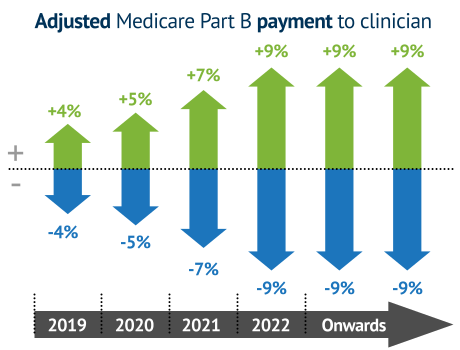
Based on the MIPS Composite Performance Score, therapists receive positive, negative, or neutral adjustments to their payments for Medicare Part B.
The potential maximum adjustment percentage increases each year the program is in effect.
MIPS quality measures you can report in TurboPT
Due to the emphasis on quality measures in the MIPS Composite Performance Score, TurboPT already allows you to report on the following quality measures:
- Measure 126: Diabetes Mellitus: Diabetic Foot and Ankle Care
- Measure 127: Diabetes Mellitus: Diabetic Foot and Ankle Care, Ulcer Prevention
- Measure 128: Preventive Care and Screening: Body Mass Index (BMI) Screening and Follow-Up Plan
- Measure 130: Documentation of Current Medications in the Medical Record — National Quality Strategy Domain: Patient Safety
- Measure 131: Pain Assessment and Follow-Up
- Measure 154: Falls: Risk Assessment — Patient
- Measure 155: Falls: Plan of Care
- Measure 182: Functional Outcome Assessment
In addition, if you are using the PTOutcome registry (APTA MIPS Registry), TurboPT has integration options available.
Track MIPS improvement activities with the TurboPT patient portal
The MIPS Clinical Practice Improvement Activity Performance Category requires a minimum selection of one activity from a list of proposed activities. Examples include coordination of care, shared decision-making, safety checklists, and expanding practice access.
TurboPT gives our clients the ability to sign patients up for the TurboPT patient portal. This allows our clients to conduct patient follow-up and track improvement activities to evaluate how patients are progressing after therapy has been completed.
If you are a current TurboPT customer, please contact support at 800-628-5844 to sign up for portal access.
MIPS reporting FAQs
What is MIPS reporting?
MIPS reporting is how clinicians submit data to CMS's Merit-Based Incentive Payment System. MIPS replaced the Physician Quality Reporting System (PQRS), which CMS discontinued on January 1, 2017, and streamlines PQRS, the Value-Based Payment Modifier, and the Medicare EHR Incentive Program into one program. Performance is summarized in a single composite score that drives Medicare Part B payment adjustments.
Can physical therapists report MIPS in TurboPT?
Yes. TurboPT lets rehab therapists enter MIPS quality measures today. As a rehab therapist you are an eligible professional under MIPS, and while therapists are not expected to submit MIPS data, you can participate voluntarily. TurboPT gives physical therapists, occupational therapists, and speech-language pathologists the ability to start reporting quality measures from the same system they document in.
Which MIPS quality measures does TurboPT support?
TurboPT lets you report eight MIPS quality measures: 126 and 127 (diabetic foot and ankle care, including ulcer prevention), 128 (BMI screening and follow-up plan), 130 (documentation of current medications), 131 (pain assessment and follow-up), 154 (falls risk assessment), 155 (falls plan of care), and 182 (functional outcome assessment).
What are the MIPS performance categories?
MIPS scores clinicians on four weighted categories: Quality, Clinical Practice Improvement Activities, Advancing Care Information, and Cost. They combine into a single composite performance score on a 0-100 point scale. Quality measures account for a large share of that score, and therapists can choose the quality measures on which they will be evaluated.
How does MIPS affect Medicare payments?
Based on the MIPS composite performance score, therapists receive a positive, negative, or neutral adjustment to their Medicare Part B payments. The potential maximum adjustment percentage increases each year the program is in effect, so the quality measures you report and the activities you track can have a growing effect on what Medicare pays your practice.
Does TurboPT work with the APTA MIPS registry?
Yes. If you use the PTOutcome registry (the APTA MIPS Registry), TurboPT has integration options available. TurboPT can also sign patients up for its patient portal so you can conduct follow-up and track improvement activities after therapy ends, supporting the Clinical Practice Improvement Activities category. Current customers can call support at 800-628-5844 for portal access.